

Why Landscape Lights Stop Working: The Short Answer
Most low-voltage landscape lighting failures trace back to one of five things: a tripped GFCI outlet feeding the transformer, a transformer or timer problem, corroded wire connectors underground, a cable nicked by a shovel or string trimmer, or a failed bulb or fixture. Start at the outlet and work outward toward the lights. If the outlet keeps tripping or the transformer is hot, humming loudly, or smells burnt, stop there and call an electrician.
Landscape lighting in the Valley lives a hard life: sun all day, irrigation every morning, and soil that swings from bone dry to saturated in a single monsoon evening. When the path lights go dark, it is usually just a weak point in the chain that finally gave out. If you would rather skip the detective work, Gideon Electric handles outdoor lighting repair and installation in Phoenix and can diagnose the whole system in one visit.
How a Low-Voltage Landscape Lighting System Works
Knowing the parts makes troubleshooting much easier. Nearly every residential system follows the same chain:
- Outdoor outlet. Usually a GFCI-protected receptacle on the house or near the garage.
- Transformer. The box plugged into that outlet. It steps household voltage down to a low voltage that is safe to run underground.
- Timer or photocell. Built into or attached to the transformer. It decides when the lights come on.
- Buried cable. Runs from the transformer out through the yard.
- Connectors. Where each fixture taps into the main cable.
- Fixtures and bulbs. The path lights, uplights, and spots you actually see.
A failure anywhere upstream takes out everything downstream. If every light is dead, look at the outlet, transformer, or timer. If only some are dead, the problem is out in the yard past the last working fixture.
Step 1: Check the Outdoor GFCI Outlet
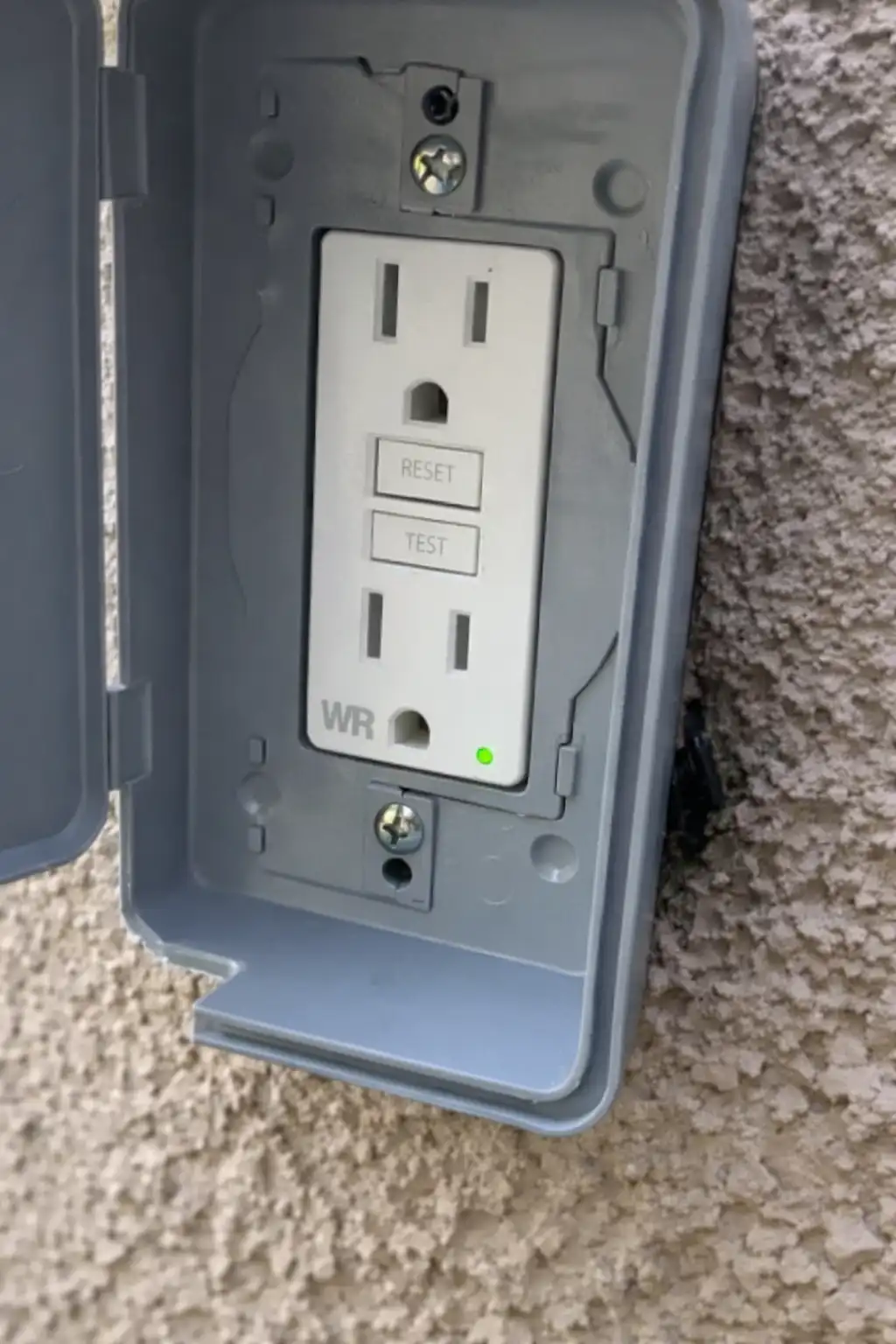
This is the first stop and the most common quick fix. Find the outlet the transformer is plugged into, look for a Reset button, and press it. If the lights come back, you are done for now, but keep an eye on it. A GFCI that trips once after a heavy rain is normal. One that trips every few days means moisture is getting into the system somewhere or the transformer is failing.
Sometimes the GFCI protecting that outlet is somewhere else, often in the garage or a bathroom, so check those too. If no GFCI will reset, or the outlet is dead after resetting, the problem has moved to the house wiring. Leave it alone and look into outlet repair and replacement instead.
Step 2: Look at the Transformer and Timer
If the outlet has power but the lights are out, move to the transformer. Confirm it is plugged in firmly and the cord is not chewed or pinched. Many transformers have their own reset button or a fuse inside the cover. Then check the timer:
- Power outages reset timers. After a monsoon outage, a digital timer may be hours off or may have lost its program. Reprogram it and the “broken” lights often come right back.
- Photocells get blocked. A photocell covered by a growing shrub, caked in dust, or pointed at a bright porch light may think it is still daytime. Clean it and clear the area around it.
- Manual override switches. Many transformers have On, Off, and Auto settings. It is easy to bump one to Off while reaching for the hose.
Now use your senses. A warm transformer is normal. One that is too hot to touch, buzzing loudly, or giving off a burnt smell is not. Unplug it and stop troubleshooting. Transformers mounted in the afternoon sun do fail outright. Monsoon lightning can damage them too, which is one more reason some homeowners add surge protection at the panel.
Step 3: Inspect the Wire Connectors
This is one of the most common failure points in a Phoenix yard. Each fixture connects to the main cable with a connector. The inexpensive pierce-style clips that come in many kits were never meant to sit in wet soil. Irrigation water and monsoon moisture get inside, the copper corrodes, and the connection gets worse a little at a time. Symptoms include flickering, dimming, a fixture that works some nights and not others, or an entire branch that goes dark.
Turn the transformer off before touching any of this. Then dig gently at the base of a dead fixture and find where it joins the main cable. Green or white crust on the copper, brittle insulation, or a connector that pulls apart in your hand confirms it. The right fix is a direct-burial rated, waterproof connector, usually gel-filled, on every splice. If the whole system was installed with the cheap kind, it will keep failing one connector at a time until they are all replaced.
Step 4: Walk the Cable Run
Low-voltage cable is tougher than it looks, but edgers, shovels, trenching for a new drip line, string trimmers, and rodents all find it. Cable left on top of the soil or under decorative rock also gets years of direct Arizona sun, and UV exposure makes the jacket brittle. Walk the run from the transformer to the last fixture looking for exposed, kinked, cut, or sun-damaged sections. A partial outage that starts at one fixture and continues to the end of the run points to a cut or bad splice near that spot.
Step 5: Check the Fixtures Themselves
If the connector and cable look good, the fixture is the suspect. Bulbs burn out, and the LED drivers inside integrated fixtures fail with heat and age. Sockets corrode. Lenses crack and fill with water. If you have a spare bulb or a known-good fixture, swap it in to confirm. And if the lights at the far end of a long run are noticeably dimmer than the ones near the transformer, that is voltage drop, not a failure: the run is too long for the cable size or carries too many fixtures, a design issue an electrician can correct.
When It Is Time to Call an Electrician
Plenty of landscape lighting problems are a five-minute fix, and we would rather you try the reset button first. These situations should go straight to a professional:
- The GFCI outlet will not reset, or trips repeatedly with the transformer unplugged.
- The transformer is hot, buzzing, scorched, or dead with power at the outlet.
- Anything on the 120-volt side needs work: the outlet, the wiring to it, or a new dedicated circuit.
- The system was installed with indoor-rated parts or non-burial connectors and keeps failing.
- You want to add fixtures or extend a run, which affects transformer sizing and cable gauge.
When connectors, cable, and fixtures are all failing together, replacing the system is often the better call than chasing one splice at a time. Gideon Electric backs new landscape lighting installations with a 10-year warranty, so you are not reliving this guide every spring.
“Armando showed up to help us with some landscape lighting which he easily resolved.”
Lights Still Out? Let Gideon Electric Take a Look
If the reset button did not do the trick, our electricians can trace the fault, replace what is failing, and set the system up to survive Phoenix weather. Call (480) 716-3272 or reach us through our contact page.
Frequently Asked Questions
Why do only some of my landscape lights work?
Is low-voltage landscape lighting safe to work on myself?
How long should landscape lighting last in Phoenix?
Can monsoon storms knock out landscape lighting?
Talk to Gideon Electric
Local electricians serving Phoenix and the Valley.